



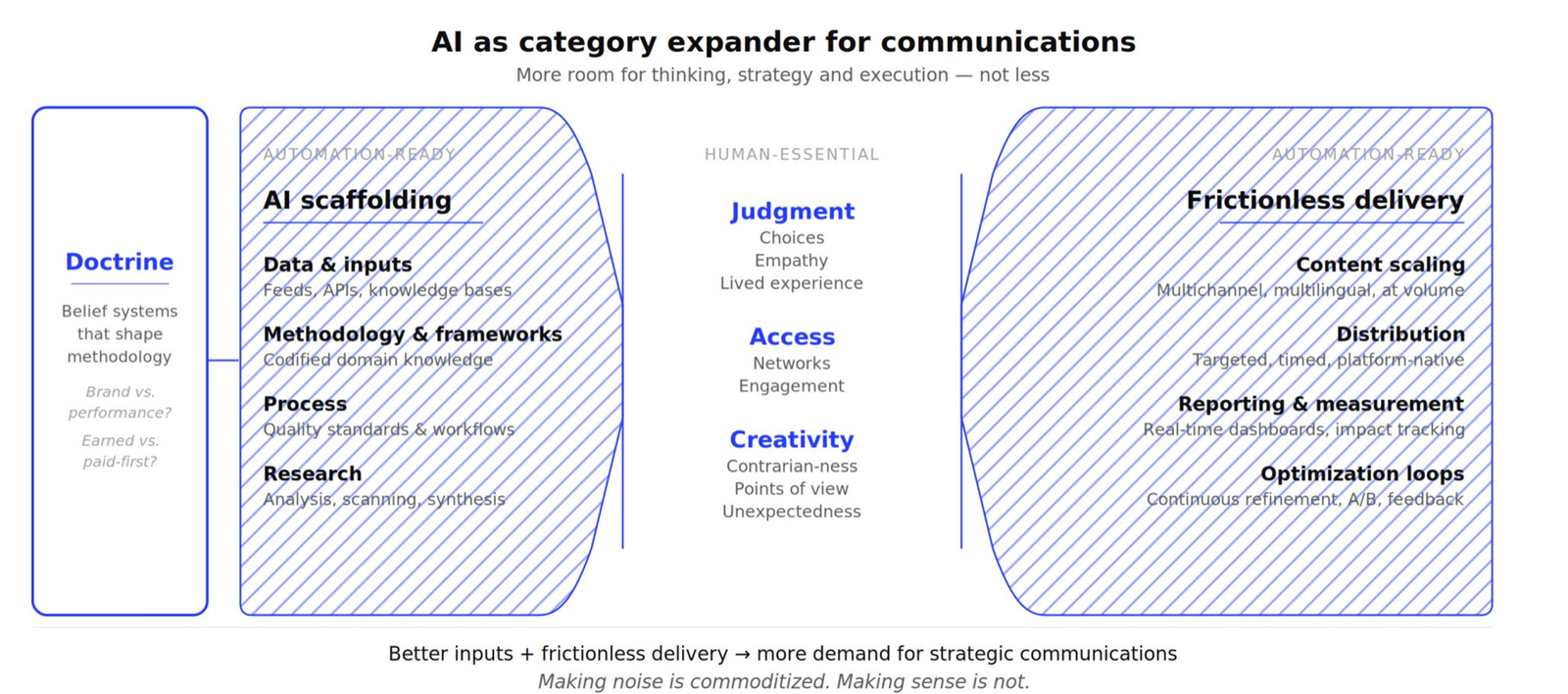
Doctrine: the belief system that defines identity
As artificial intelligence becomes embedded in communication and public affairs, "doctrine" will become more important than before. With doctrine, I mean: what do we think of our profession, and how does what we think differ from others?
Understanding why we do the things that we do – the belief system that underpins our work – has always mattered. But in an AI-driven world, this will almost single-handedly define the identity of a professional service company. This doctrine will shape the methodologies, frameworks and processes that firms use in their work — and will ultimately shape the outcomes.
"We shape our buildings, and afterwards our buildings shape us."
AI Scaffolding: from belief to process
Doctrine is codified into processes, workflows, and informs which feeds, analysis and research is performed. AI will accelerate this, which is relatively straightforward and already ongoing.
Historically, clients have undervalued desk research for professional service firms, seeing it as something professionals should already know or a "waste of time". AI changes that dynamic, making deeper analysis more accessible without increasing budgets. This benefits the overall quality of communications work.
Likewise, AI will introduce a new level of control and consistency over processes in knowledge work. It's something that manufacturing nailed in the 1970s but services never managed. AI might deliver it and close this gap. As someone who spent 10 years advocating that "lean approaches are about quality, not efficiency and cost-cutting", this is very tantalizing.
Human Intervention: the critical layer
This leads to the most critical layer: the human intervention. What do we – as humans — think of this? What do we think others will think of it and do with it? How can we influence this? How can we translate this in an approach, a plan, a creative concept? Who do we need to see first? What's their feedback?
In an ideal world, compressing the processes and frameworks will create more time for this crucial phase of the work. Or it would enable faster iteration and shorter feedback loops, allowing time for more refined and responsive strategies.
Frictionless distribution and production
AI will enable near-frictionless distribution and production — which is a bit of a double-edged sword. Nobody wants to live in a world of AI slop; on the other hand, ubiquitous advertising and spam email have refined people's filtering. Research shows that most advertising is simply ignored. Breaking through this filter will require understanding of audiences, creativity and permission. It will raise the bar for communication.
Measurement and reporting
Finally, there is the measurement, reporting, and benchmarking. Similar to desk research, this is mostly taken for granted by clients, although it can be enormously time-consuming and deeply unprofitable. Automating this while elevating the quality of the reporting will likely give clients more confidence to invest more in communication and public affairs work — bringing high-quality, strategic communication in reach for smaller organizations (SMEs, smaller municipalities) too.
"If AI expands the category, it also sharpens the question of where real value lies. In a landscape where everything becomes easier to generate, the scarce resource is not content but clarity."
The firms that win will be those that combine strong doctrine with sharp human judgment, using AI not just to scale output, but to elevate thinking. That is where communication stops being noise, but will make sense.